

Discover What Is Bitcoin, explore the role of the Strategic Bitcoin Reserve, how ETFs shape adoption, and expert insights on the price of Bitcoin by 2030.
Table of Contents
ToggleIntroduction
What Is Bitcoin? That’s the million-dollar question echoing across global financial markets. Since its mysterious launch in 2009 by the anonymous creator Satoshi Nakamoto, Bitcoin has grown from an obscure digital experiment into the world’s most powerful decentralized currency. Institutions, governments, and retail investors are now not just holding Bitcoin but strategically planning around it. Concepts like the Strategic Bitcoin Reserve and Bitcoin Exchange-Traded Funds (ETFs) have added new momentum to its mainstream adoption. But the ultimate question remains: How much will the price of Bitcoin be worth in 2030? Let’s dive deep into Bitcoin’s fundamentals, its strategic importance, and its future outlook.
What Is Bitcoin? A Beginner-Friendly Complete Breakdown

Bitcoin is digital money without borders. It’s built on blockchain technology, a transparent public ledger where every transaction is recorded permanently. Unlike traditional currencies issued by central banks, Bitcoin is decentralized and scarce, with a hard cap of 21 million coins.
Key Bitcoin Features:
Decentralization: No single authority controls it.
Scarcity: Only 21 million BTC will ever exist.
Transparency: Transactions are publicly verifiable.
Security: Based on Proof-of-Work (POW) mining mechanism and cryptography.
According to Wikipedia, Investopedia, Bitcoin’s limited supply makes it a deflationary asset, unlike fiat currencies prone to inflation. This scarcity is a major driver of its price.
In simple terms, Bitcoin is digital gold only easier to store, transfer, and secure.
Bitcoin is built on blockchain technology, if you’re new to the concept, check out our detailed article guide on (Blockchain Fundamentals).
Why Strategic Bitcoin Reserve Matters in Modern Finance

The Strategic Bitcoin Reserve is becoming a financial defense tool. Just as nations hold gold reserves to secure economic stability, Bitcoin is now being viewed as a hedge against inflation and currency devaluation.
How Strategic Bitcoin Reserves Work:
Nations & Institutions: Governments and corporations hold BTC as part of their balance sheets.
Economic Hedge: Protects against fiat currency risks and inflation.
Liquidity Buffer: Ensures access to non-sovereign capital during global crises.
Examples:
El Salvador became the first country to adopt Bitcoin as legal tender and actively builds a national BTC reserve.
Corporates like MicroStrategy & Tesla hold billions worth of Bitcoin as part of their treasury strategy.
In the future, central banks may diversify with Strategic Bitcoin Reserves, signaling global trust in Bitcoin as a parallel store of value.
Bitcoin ETFs – A Gateway to Mainstream Adoption

Bitcoin ETFs (Exchange-Traded Funds) allow traditional investors to gain Bitcoin exposure without directly owning it. This innovation bridges the gap between Wall Street and decentralized finance.
Why Bitcoin ETFs Are Important:
Accessibility: Investors can buy Bitcoin exposure like stocks.
Regulatory Oversight: ETFs are approved and monitored by regulators.
Market Legitimacy: Institutional investors feel safer.
Liquidity Boost: More capital flows into Bitcoin markets.
According to Forbes, Bitcoin ETFs in the U.S. attracted billions of dollars in inflows in just months after launch. This institutional wave is fueling demand and strengthening Bitcoin’s case as a mainstream asset.
ETFs are to Bitcoin what PayPal was to online payments a bridge from early adopters to the masses.
Understanding how Bitcoin fits into the broader crypto ecosystem requires a look at our article on (Blockchain Consensus & Layers).
The Price of Bitcoin – Historical Trends & Volatility
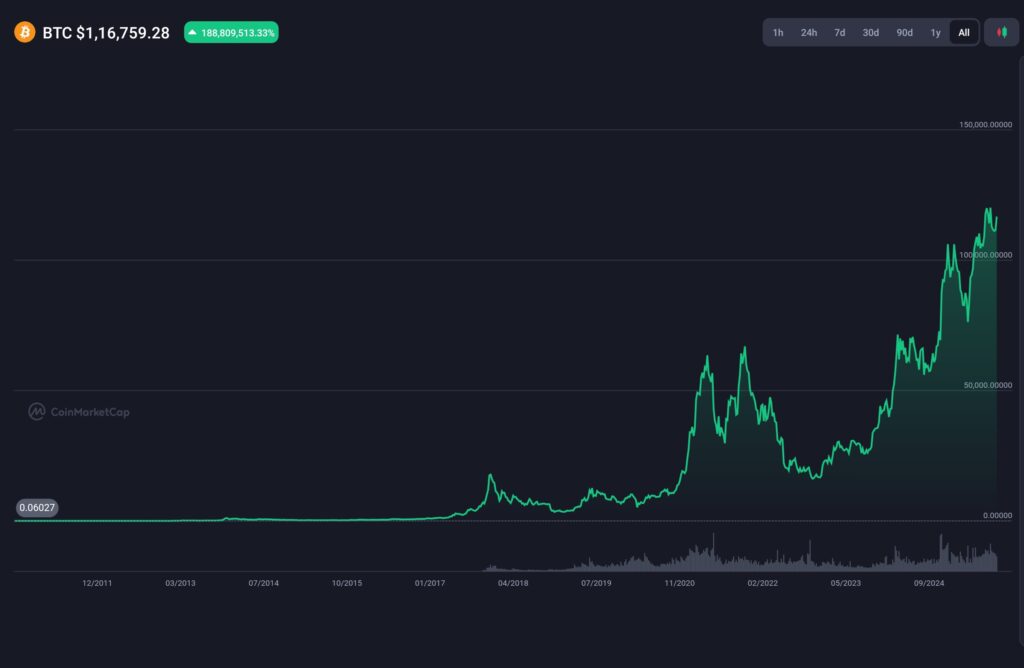
The price of Bitcoin has seen meteoric highs and gut-wrenching lows. From being virtually worthless in 2010 to reaching $69,000 in 2021, its journey shows both opportunity and risk.
Historical Price Milestones:
2010: $0.003 (first real trade – 10,000 BTC for 2 pizzas)
2013: $1,000 (mainstream attention began)
2017: $20,000 (crypto mania peak)
2021: $69,000 (institutional boom)
2022–2023: $16,000–$30,000 (bear market correction)
2025: $126000 (ETFS Hype and Big Bulls entry like BlackRock)
Bitcoin’s price follows a four-year halving cycle, where mining rewards are cut in half. This reduces supply, historically triggering bull runs.
Bitcoin in 2030 – Expert Predictions & Scenarios

The million-dollar question: How much will Bitcoin be worth in 2030? Analysts and institutions have different outlooks.
Bullish Predictions:
BlackRock: Calls Bitcoin is the best class Store of value asset and its like Digital Gold
Cathie Wood (ARK Invest): BTC could reach $1 million+ by 2030.
Fidelity: Calls Bitcoin a superior store of value vs. gold.
Max Keiser: Predicts over $500,000 as global adoption rises.
Bearish Predictions:
Some economists warn Bitcoin could face regulatory challenges and stagnation.
Skeptics like Warren Buffett call it “rat poison squared.”
Realistic Scenarios by 2030:
1. Adoption Boom → Bitcoin $500K–$1M.
2. Moderate Growth → Bitcoin $100K–$250K.
3. Regulatory Clampdown → Bitcoin under $50K.
With growing Strategic Bitcoin Reserves and ETFs, the middle-to-bullish scenario seems most likely.
Why Investors Consider Bitcoin a Strategic Asset

Bitcoin isn’t just speculation; it’s becoming a strategic allocation in investment portfolios.
Benefits of Holding Bitcoin:
Hedge against inflation
Diversification beyond stocks & bonds
Borderless transactions
Potential long-term growth
Many wealth funds, hedge funds, and even retirement portfolios now include Bitcoin. The Strategic Bitcoin Reserve concept could amplify institutional adoption further.
Risks & Challenges Ahead for Bitcoin

Despite its massive potential, Bitcoin faces risks.
Key Challenges:
Regulation: Governments may restrict or heavily tax Bitcoin.
Volatility: Price swings can scare off conservative investors.
Energy Concerns: Mining consumes high energy, though green solutions are emerging.
Competition: Newer blockchains may challenge Bitcoin’s dominance.
Bitcoin has survived multiple “deaths” declared by critics, yet it continues to rebound stronger.
The Future of Strategic Bitcoin Reserve & Global Finance

By 2030, Strategic Bitcoin Reserves could become as common as gold holdings today. With ETFs making access easier and Bitcoin’s fixed supply driving scarcity, its role in global finance is set to expand.
Nations may compete to accumulate Bitcoin reserves.
Corporates may shift treasury policies toward digital assets.
Individuals may see BTC as essential in retirement planning.
Bitcoin’s future will likely mirror the internet’s rise slow, doubted at first, then unstoppable.
FAQs
Q1: What Is Bitcoin in simple terms?
Bitcoin is decentralized digital money that runs on blockchain. It is scarce, secure, and not controlled by any government.
Q2: What is a Strategic Bitcoin Reserve?
A Strategic Bitcoin Reserve is when governments, institutions, or corporations hold Bitcoin as part of their economic or treasury strategy, similar to gold reserves.
Q3: How much will the price of Bitcoin be worth in 2030?
Predictions vary — conservative estimates suggest $100K–$250K, while bullish forecasts reach $500K–$1M per Bitcoin.
Q4: Are Bitcoin ETFs safe for beginners?
Yes, Bitcoin ETFs provide regulated exposure to Bitcoin, making them easier for traditional investors to access compared to directly owning BTC.
Conclusion
Bitcoin has moved far beyond the question of What Is Bitcoin. With Strategic Bitcoin Reserves, growing ETF adoption, and an ever-rising global demand, it is becoming a cornerstone of modern finance. While risks remain, Bitcoin’s resilience suggests it will play a dominant role in the financial landscape of the next decade.
👉 If you’re planning your long-term investment strategy, now is the time to stay informed, diversify, and consider Bitcoin’s place in your portfolio.
1 thought on “What Is Bitcoin? Strategic Bitcoin Reserve, ETFs & Price Prediction 2030”